
Wow, I re-uploaded that FAST. But in all seriousness, you'll notice my intro song is gone now. Apparently it isn't copyright friendly. AFTER AN ENTIRE YEAR O. Visit the SD Association’s website and download SD Formatter 4.0 for Windows or Mac. Follow the instructions to install the software. Insert your SD card into the computer or laptop’s SD card reader and make a note of the drive letter allocated to it, e.g. In SD Formatter, select the drive letter for your SD card, and format it.
The Raspberry Pi is an incredible device, but it won’t do much of anything without an operating system. Luckily, choosing and installing an appropriate operating system on your Raspberry Pi has never been easier. One simple method is to use NOOBS, or “New Out of Box Software.” As the name suggests, NOOBS is perfect for Pi newbies. It lets you choose your preferred operating system and install it right then and there. But how do you load NOOBS itself? Here’s our complete guide on how to install NOOBS on the Raspberry Pi.
Luckily for us, the process is extremely simple. All you’ll need is a Raspberry Pi, a computer, and an SD or microSD card. Check out the complete instruction below.
How to install NOOBS on the Raspberry Pi
We’ve called our article “How to install NOOBS on the Raspberry Pi,” but what we’re technically doing is installing it on a flash drive, booting to the drive on the Raspberry Pi, and then using NOOBS to choose and install an operating system.
NOOBS has plenty of operating systems for us to choose from when we reach that step – the most notable of which is Raspbian. For now, though let’s concentrate on how to install NOOBS on the Raspberry Pi. We will briefly discuss the operating system installations later, in our final step.
The optional easy route: buy a NOOBS SD card.
Installing NOOBS on an SD card isn’t hard, but it also isn’t necessary. If you’d like, you can choose to buy an SD card that comes pre-loaded with NOOBS. If you go that route, you can skip all the way to the final step!
If you want to do things yourself, though, just read on.
What you’ll need to install NOOBS on the Raspberry Pi
This project is pretty simple. Besides your Raspberry Pi and essential peripherals, here’s all you’ll need:
- A computer with an SD card slot
- An SD or microSD card of at least 8 GB
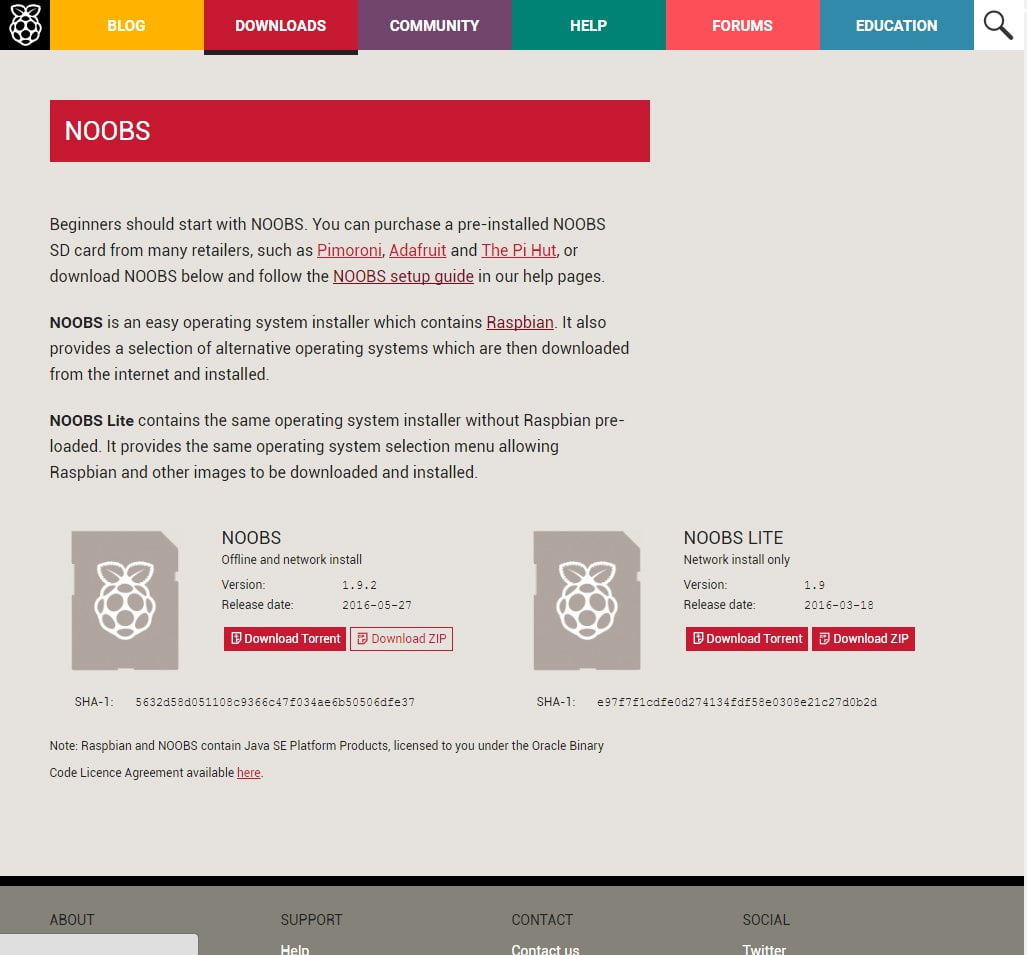
Step 1: Download NOOBS and extract it
You’re going to use your computer to put NOOBS on an SD card – so step one is to get NOOBS onto your computer!
The NOOBS download page will let you choose between NOOBS and “NOOBS Lite.” NOOBS includes a full version of Raspbian, so you can install that particular operating system without using the internet at all. With NOOBS Lite, on the other hand, you’ll need a network connection to install any of the operating systems NOOBS makes available – even Raspbian.
Go ahead and choose whichever version you would like. NOOBS will download as a .zip file, so before you do anything else, go ahead and extract it.
Step 2: Format an SD card

Now you’re going to want to go ahead and stick your SD card into the corresponding slot on your computer. You’re going to want to format it as FAT. There are a few ways to do this:
On Mac or Windows, use the SD Association’s Formatting Tool (Mac users can also just use the disk utility). Make sure the “Format size adjustment” option is set to “on.” Then erase it in FAT (or MS-DOS) format.
Step 3: Put the NOOBS files on the SD card
Now, just drag and drop the NOOBS files into your newly formatted SD card. You want the files only, so if your .zip extracted to a folder, open that folder up and select only the stuff inside of it.
Step 4: Put your SD card into your Raspberry Pi and boot it up
Once you have NOOBS on your SD card, using it is incredibly easy. Just put the SD card into your Raspberry Pi and start that sucker up. As we said before, while this guide is called “How to install NOOBS on the Raspberry Pi,” the endgame here is actually to install an operating system like Raspbian, LibreELEC, OSMC, or any of the others NOOBS gives you access to.
This is the step in which that happens. After booting to NOOBS, you’ll be greeted with a menu that will let you choose which operating system you’d like to install on your Pi. Your menu may look a little bit different than the one in the screenshot above, because NOOBS ingeniously adapts to your generation and model of Raspberry Pi.

Which OS should you choose? Well, that’s up to you. Raspbian is probably the most frequently used, and you’ll find plenty of projects here on our site that utilize it. OSMC acts as a media center, and LibreELEC boots directly to the popular media center app Kodi. Ultimately, it’s all a matter of personal preference!
Once you’ve decided, just hit “Install” and sit back. From now on, your Pi will boot directly to that operating system. Easy, right?
And if you’re not happy with the operating system you pick, you’re not stuck. Just hold down the SHIFT key while booting up, and you’ll be back in the NOOBS menu ready to try out a different option.
Get started with a Raspberry Pi the easy way. New out of the Box Software or NOOBS is a utility to make installing Operating Systems for the Raspberry Pi simpler for Raspberry Pi beginners but also can be used as a recovery system useful for more advanced users.
The Raspberry Pi is aimed at educating and getting people interested in learning how computers work by promoting simple programming and being creative with electronics. Some people using a Raspberry Pi for the first time may have never of used a Linux operating system and struggle to install the OS onto a SD memory card to get a Raspberry Pi set-up and running for the first time. For some people this will be a challenge they will want to overcome but other people my find this slightly too difficult to do and give up and that’s not good for the new user, the Raspberry Pi community or computing in general. So to make the first steps a bit easier NOOBS was developed by a small team of Raspberry Pi enthusiasts.
NOOBS , stands for New Out Of the Box Software, is a utility that comes in a downloadable zip file that can be extracted on to at least a 4GB SD memory card using a Windows, Apple Mac or Linux based computer.

Once the SD memory card is ready it can be inserted in the Raspberry Pi and started up. NOOBS will display a list of operating systems that can be installed by simply selecting it from the menu. Once the installation is complete you are ready to go. Next time you start up the Raspberry Pi it will load straight into your chosen Operating System. The NOOBS utility will be hidden unless you press shift next time you start up the RPi.
This process is simpler than the standard method as it does not require any extra software to create the SD memory card image and no internet connection is needed for the installation. If you do have a problem with installing your chosen operating system NOOBS has features to help you out including a web browser so you can go online and search for a solutions in the RaspberryPi.org user forums.
As the Raspberry PI can connect to a display by a HDMI cable or a composite cable some users may experience a problem getting anything to display especially with a composite display as the NOOBS expects to be used on a HDMI display. If nothing is being displayed when you first load NOOBS then selecting 1,2,3 or 4 on the keyboard will select different HDMI and Composite modes one of which should get the display working for you.
NOOBS Operating Systems
The Operating systems that are available with NOOBS v1.3 are:
- Raspbian - The recommended operating system for the Raspberry Pi based on Debian Linux.
- Raspbian boot to Scratch - Raspbian as the option above that loads straight into Scratch.
- Pidora - A version of Fedora Linux that has been optimised to be used with a Raspberry Pi.
- Arch Linux Arm - for competent Linux users who want to configure a system from the base up to their requirements.
- Risc OS - An early operating system developed by ARM which includes BBC Basic widely used in schools to teach programming during the 80s.
- OpenELEC - A XBMC multimedia center to turn your TV into a Smart TV for music, video, demand TV and online content.
- RaspBMC - An alternative XBMC multimedia center based on Raspbian so other software can be used as well as XBMC.
Data Partition - Add a 512mb data partition for data that will be kept safe during a re-instalation of an operating system.
From version 1.3 you can install more than one Operating System to the SD memory card at a time. You can then choose which one you want to use at boot time. Operating systems can also be installed from the internet so they no longer need to be available on the SD card before they are installed.
Installation
To install NOOBS you will need at least a 4gb good quality SD memory card and use of a desktop computer or laptop.
Download a SD memory card formatting tool from here SD Formatter available for Windows and Mac computers. Though both the Windows and Mac operating systems can format an SD card to the required FAT32 format, they do not use the full feature of a SD card. So using the SD Associations SD formatter utility will correctly format the memory card. Linux users can use gparted.
Then use the utility to format you SD card.
Insert your SD memory card in to the computer and select refresh. In this image it has been found in drive I.
Then select Format. Select OK to the Warning about a quick format.
Once the SD card has been formatted you are ready to install NOOBS.
Knobs For Machinery
The NOOBS file is in a zip archive file that can be extracted straight to the SD memory card. Once complete insert the memory card into your Raspberry Pi and switch it on. NOOBS will load for you to select your desired operating system.
NOOBS can be downloaded from the Raspberry Pi foundation website here where you can find more information and a full guide on how to install and use NOOBS.
NOOBS Recovery System
NOOBS can also be used as a recovery system as it keeps the original copy of the operating systems hidden away, if you do need to re-install an operating system then you can just reselect it from the NOOBS menu and it will be installed again, removing all trace of the previous installation. This is a good option if you are developing software and need to have frequent clean installs or you are a teacher and need to reset your Raspberry Pi's before you start a new course.
Adding a customised OS image to NOOBS
It is possible to add a customised OS image to NOOBS v1.2 which is useful for schools as it allows for images to have additional software and set-ups installed as standard.
In simple terms modify an OS to your required setup. Create a disk image and convert it to a compatable partition set-up and then compress the image to use minimal space. Next copy the disk file to the image folder on NOOBS and your custom OS will be available for use.
mr-minifig on github has created a script to convert a disk image and also a step by step guide to manually prepare a disk image to be compatable with NOOBS and install it. github.com/mr-minifig/Pi-Noobs-Converter
Version 1.3 of Noobs uses compressed tarball archives of the disk image which is a different method to 1.2.
Noobs Format Sd Card
Instructions are available at github.com/raspberrypi/noobs/blob/master/README.md near the bottom of the page.
Knobs For Maytag Stove
.
Comments are closed.